The Skilled Trade Shortage: What’s Driving Demand in 2026


Across Australia, the skilled trade shortage has moved from a looming concern to a critical operational challenge. In 2026, demand for qualified tradespeople continues to outpace supply, placinng pressure on manufacturing, FMCG, transport and logistics, warehousing and waste management operations nationwide.

This shortage is not the result of a single issue. It reflects a combination of ageing workforces, infrastructure investment, evolving compliance requirements and shifting workforce expectations. In response, employers are increasingly relying on workplace learning, flexible learning, online courses and targeted upskilling to maintain productivity and manage risk.

Labourpower works closely with national clients and sees this demand intensifying across regions, particularly for skilled roles that are essential to operational continuity.


Why Skilled Trades Are in Short Supply

Skilled trades form the backbone of Australia’s industrial economy. Electricians, fitters, mechanics, maintenance technicians and licensed operators play a critical role in keeping facilities, fleets and infrastructure running.

However, several factors have contributed to ongoing shortages:

  1. A large portion of the skilled workforce is approaching retirement
  2. Apprenticeship completion rates have not kept pace with demand
  3. Competition for skilled labour has intensified across industries
  4. Project-based work and infrastructure investment are absorbing talent

As demand increases, employers are finding it more difficult to secure experienced tradespeople at short notice, particularly across multi-site operations.


Manufacturing and Infrastructure Investment Fuel Demand

One of the strongest drivers of skilled trade demand in 2026 is continued investment in manufacturing capability, infrastructure projects and supply chain resilience.

Manufacturing facilities are upgrading equipment, automating processes and expanding capacity. These changes require skilled trades to install, maintain and operate complex systems. At the same time, infrastructure projects are drawing from the same talent pool, increasing competition for labour.

This demand places pressure on employers who rely on skilled trades to meet production targets, safety requirements and maintenance schedules.


Compliance and Safety Expectations Are Rising

Skilled trades are subject to increasingly stringent compliance and safety requirements. Licensing, certifications and site-specific credentials are now essential for many roles.

According to Safe Work Australia, inadequate training and competency gaps continue to contribute to workplace incidents. As a result, employers are strengthening their expectations around documented skills and ongoing competency development.

In this environment, experience alone is no longer sufficient. Employers require evidence of capability, and workers must maintain relevant credentials to remain employable.


The Role of Workplace Learning in Closing Skills Gaps

With fewer experienced trades available, employers are focusing on developing capability internally. Workplace learning allows organisations to build skills while maintaining productivity.

Rather than relying solely on external recruitment, employers are using structured learning pathways to:

  1. Develop semi-skilled workers into trade-adjacent roles
  2. Support progression within existing teams
  3. Reduce reliance on a limited external talent pool

Workplace learning embedded into daily operations allows skills to be built progressively, supported by supervision and real-world application.

Labourpower supports clients by aligning workforce supply with learning strategies that strengthen capability while meeting Australian standards.


Flexible Learning and Online Courses for Skilled Workforces

Traditional classroom training often does not suit skilled trade environments. Shift work, remote sites and production demands require more adaptable learning models.

Flexible learning and online courses enable workers to complete training around operational requirements. This approach allows employers to upskill teams without removing them from critical roles for extended periods.

For skilled trades, flexible learning supports:

  1. Faster onboarding into site-specific requirements
  2. Ongoing compliance with licensing and safety expectations
  3. Continuous skill development as technology evolves

In 2026, learning flexibility is essential to maintaining a skilled workforce.


Upskilling as a Workforce Stability Strategy

Upskilling plays a key role in stabilising skilled workforces. When skilled workers feel supported in maintaining and expanding their capability, they are more likely to stay engaged and committed.

Upskilling contributes to:

  1. Improved retention of experienced workers
  2. Safer work practices
  3. Stronger leadership and supervision capability
  4. Reduced downtime caused by skills shortages

For employers, investing in upskilling reduces risk and builds resilience across operations.


Why Recruitment Alone Cannot Solve the Trade Shortage

In 2026, the skilled trade shortage cannot be solved through recruitment alone. The limited supply of experienced trades means employers must adopt broader workforce strategies.

National clients are increasingly seeking recruitment partners who:

  1. Understand trade-specific labour markets
  2. Support onboarding and compliance requirements
  3. Provide access to learning and upskilling pathways
  4. Offer scalable workforce solutions across sites

Labourpower positions itself as a workforce partner that understands the full lifecycle of skilled trade supply, from attraction and placement through to capability development.


Australian Standards and Responsible Workforce Development

All workforce development initiatives must align with Australian legislation and regulatory frameworks. Employers have obligations under Work Health and Safety legislation to ensure workers are trained, competent and supervised.

Training and learning solutions must also align with nationally recognised standards where applicable. Authoritative guidance is available through:

  1. Safe Work Australia
  2. Fair Work Australia
  3. Australian Skills Quality Authority

Labourpower aligns its workforce and learning practices with these frameworks, supporting compliance and responsible workforce development.


What Forward-Thinking Employers Are Doing in 2026

Organisations managing skilled trade shortages effectively are:

  1. Investing in internal capability development
  2. Using flexible learning to maintain skills at scale
  3. Partnering with recruitment providers who understand trade supply challenges
  4. Treating upskilling as a long-term workforce strategy

These employers recognise that skilled labour is not just sourced. It is built.


Partner With Labourpower to Navigate the Skilled Trade Shortage

The skilled trade shortage is expected to continue in 2026 and beyond. Manufacturing, logistics and industrial operations must adapt to remain competitive and compliant.

Labourpower supports national clients with workforce solutions that combine skilled labour supply, workplace learning, flexible learning, online courses and targeted upskilling. This integrated approach helps businesses manage demand, reduce risk and build sustainable capability.

If your organisation is facing skilled trade shortages or planning for future demand, speak with Labourpower about how we can support your workforce strategy.

FROM AWARENESS TO ACTION: IDENTIFYING HAZARDS THAT PROTECT YOUR PEOPLE

Every safe workplace starts with awareness. The moment we recognise and act on hazards, we protect not only compliance and productivity but, more importantly, our people.

Safe Work Australia highlights that identifying hazards is the first step in risk management. Under the model WHS Act, employers (PCBUs) have a duty to spot and address hazards in every workplace environment. This responsibility isn’t just a legal box to tick, it’s about building a culture where workers go home safe – every single day.

When employers identify hazards early, they can:

  • Prevent injury and illness before they occur.
  • Support a healthier, more confident workforce.
  • Build trust with employees by showing that safety is a priority.
  • Maintain compliance with WHS laws and reduce costly downtime.

At Labourpower, we believe safety goes 24/7. That means being proactive in hazard identification and ensuring that every person we place is prepared for safe and effective work from day one.


Why Identifying Hazards Matters


Hazards aren’t always obvious. They may be physical (such as slippery floors or faulty equipment), ergonomic (poor manual handling practices), or even psychosocial (including fatigue, bullying and stress). Employers who make hazard identification a daily habit build stronger safety cultures and more resilient teams.

Safe Work Australia provides clear guidance:

  • Hazards must be identified before work begins, whenever changes occur, and as part of regular reviews.
  • Workers must be consulted, as they often notice risks firsthand.
  • Employers must take steps to eliminate risks where possible, or minimise them as far as reasonably practicable.

Reference: Safe Work Australia – How to Manage Work Health and Safety Risks


Practical Ways Employers Can Identify Hazards


  1. Workplace inspections – Walk through regularly, looking beyond the obvious.
  2. Engage your team – Toolbox talks, feedback loops, and near-miss reporting give real insight.
  3. Use hazard checklists – Cover physical, chemical, biological, ergonomic, and psychosocial hazards.
  4. Review data – Past incidents and near misses are a goldmine of lessons.
  5. Monitor change – New equipment, materials, or processes = new hazards to identify.


Labourpower’s Commitment


When you partner with Labourpower, you don’t just get skilled staff; you get people who have already been inducted in safety awareness and assessed for industry-specific risks. Our teams arrive trained, reliable, and ready to contribute to safe, productive operations.

We know that for employers, identifying hazards is about more than compliance. It’s about protecting lives, maintaining trust, and ensuring that every worker feels supported and valued. And for us, it’s personal: every placement is a person with a family to go home to.

This Safe Work Month, take the lead in protecting your workforce by identifying hazards early. Labourpower can help you implement practical hazard awareness strategies while providing a workforce that is safety-ready from day one.

Talk to our team of recruitment specialists today on (02) 8336 6200!


Barry Geaitani
National HSEQ Manager


SAFE WORK MONTH 2025: SAFETY GOES 24/7 AT LABOURPOWER

October marks National Safe Work Month 2025, an initiative led by Safe Work Australia to highlight workplace health and safety across all industries. This year’s theme reminds us to prioritise ‘Safety: Every Job, Every Day’ and make it a reality through a proactive approach to managing WHS risks.

At Labourpower, we live and breathe this philosophy every day!

As the National HSEQ Manager, with over 30 years’ experience in workplace health, safety, environment, and quality management, I’ve seen one truth stand out:

Safety doesn’t clock off at 5 pm – safety goes 24/7.


Safety Goes Beyond the Workplace


For many businesses, safety is seen as something that starts at the warehouse gate and ends at the clock-off siren. But, in labour hire and recruitment, safety follows our people into every corner of their day:

  • On the job, whether driving a forklift, loading freight, or working in an office, hazards must be identified, risks managed, and safe practices followed.
  • On the road, fatigue, distraction, and poor planning can turn commutes or client site travel into serious risks.
  • At home, practising safe lifting, proper ergonomics, and mindfulness around wellbeing can prevent injuries and stress that can spill over into the workplace.

At Labourpower, we encourage our teams and clients to view safety as a 24/7 commitment because a safe worker on shift is supported by safe habits off shift.


Building a Culture of Safety – Not Just Compliance


It’s easy to talk about policies and procedures, but a genuine safety culture is built on trust, leadership, and daily practice.

At Labourpower, we’ve made safety part of our DNA by:

  • Embedding HSEQ inductions into every onboarding process.
  • Running regular toolbox talks with labour hire staff across client sites.
  • Leveraging technology and reporting tools to monitor hazards in real time.
  • Providing mental health support to ensure psychological safety is valued just as highly as physical safety.

In essence, safety is not just a rulebook we hand to employees – it’s a shared value that drives everything we do.


The Current Challenges in Recruitment & Labour Hire


In 2025, the recruitment and labour hire industry faces some pressing safety challenges, for example:

  • Fatigue management – with shift work and high-demand environments, ensuring workers are rested and fit for duty remains a top priority.
  • Manual handling injuries – still one of the biggest risks in warehousing, logistics, and manufacturing.
  • Workforce diversity – adapting safety programs for a multicultural workforce, ensuring training is clear, inclusive, and effective.
  • Psychosocial hazards – stress, workload, and bullying are emerging as major factors impacting staff wellbeing, reinforced by updated WHS regulations.

By staying ahead of these challenges, Labourpower ensures that our clients receive not only skilled staff but also safe, supported staff.


Why Safety Matters to Everyone? Clients, Candidates & Communities


For clients, safety means fewer disruptions, lower costs, and a stronger brand reputation.
For candidates, it means confidence, security, and the knowledge that their employer values them.
Most importantly, for the community, it means families know their loved ones come home safe every day.

At Labourpower, we take pride in being more than a labour hire agency – we are workforce safety partners.


Safe Work Month 2025 – Call to Action


This Safe Work Month, we encourage every business leader, site supervisor, and employee to ask themselves:

What can I do today to make my workplace safer tomorrow?

At Labourpower, we will continue to lead by example, investing in safety, embedding strong practices, and reminding our people that Safety Goes 24/7. Because in the end, nothing matters more than ensuring every person who puts on the Labourpower uniform returns home safe, every single day.


Plan of Action


Safe Work Australia has structured the month around a four-tiered risk-management framework, with a different focus each week:

  1. Identify Hazards
  2. Assess Risks
  3. Control Risks
  4. Review Controls


Week 1: Identify Hazards

In recruitment, this process begins with matching. We map client environments, site conditions, and candidate capabilities through pre-start assessments and site inductions, identifying potential hazards early.

Week 2: Assess Risks

Not all hazards pose the same risk. Therefore, we evaluate the likelihood and severity, prioritising high-impact areas—such as forklift zones, confined spaces, and manual handling—before placements begin.

Week 3: Control Risks

Here’s where we act, for instance:

  • Deploy appropriate PPE (helmets, visibility, gloves).
  • Provide site-specific training, including safe forklift operation and hazard reporting through digital tools like our Labourpower App.

Week 4: Review Controls

Safety isn’t a set-and-forget checklist. Consequently, we conduct regular safety audits and toolbox talks, ensuring controls remain effective and evolve with the worksite.


Hot WHS Trends in 2025


  • Digital Risk Management: Regulators are scrutinising how technology is used for hazard identification and worker communication. Accordingly, employers must ensure tools facilitate real-time reporting without distraction.
  • Psychosocial Safety: Burnout and mental strain are now acknowledged hazards. We integrate psychological risk controls, Peer SafeTea sessions, and mental health awareness during NSWM.
  • Behaviour-Based Safety: Inspired by initiatives like Daracon’s BBS program, we reinforce safe behaviour through leadership visibility, positive reinforcement, and worker feedback loops.


Safe Work Month – How You Can Take Action


A Blueprint for Safety

Strategy Action Step
Leverage Safe Work Australia Resources Utilise their Canva toolkits, posters, SafeTea event ideas, and social media tiles to reinforce safety visually.
SafeTea Toolbox Talk Host a safety-themed morning tea with site-specific discussions to spark meaningful engagement.
Worker Involvement Engage workers in hazard hunts and quick risk-spotting competitions to reinforce ownership and accountability.
Psychosocial Health Check Offer brief mental wellbeing check-ins, guided by EAP/safety advisors.
Digital Audits Share workplace safety survey links via your internal network to gather quick feedback and gain valuable risk insights.


With 30+ years in safety leadership, I’ve seen firsthand that safety is rarely the most visible aspect—until it’s missing. National Safe Work Month 2025 isn’t just a calendar entry. It’s a national reminder that safety must come first in every shift, every job, every day.

Let’s make safety real, practical, and universal. Because every Australian deserves to return home safely every day.

– Barry Geaitani, National HSEQ Manager


Resources & Further Reading


Looking for a recruitment partner who puts safety first? At Labourpower, safety isn’t just a policy – it’s a promise. Contact us today to discover how our labour hire solutions keep your workforce safe, strong, and supported 24/7!


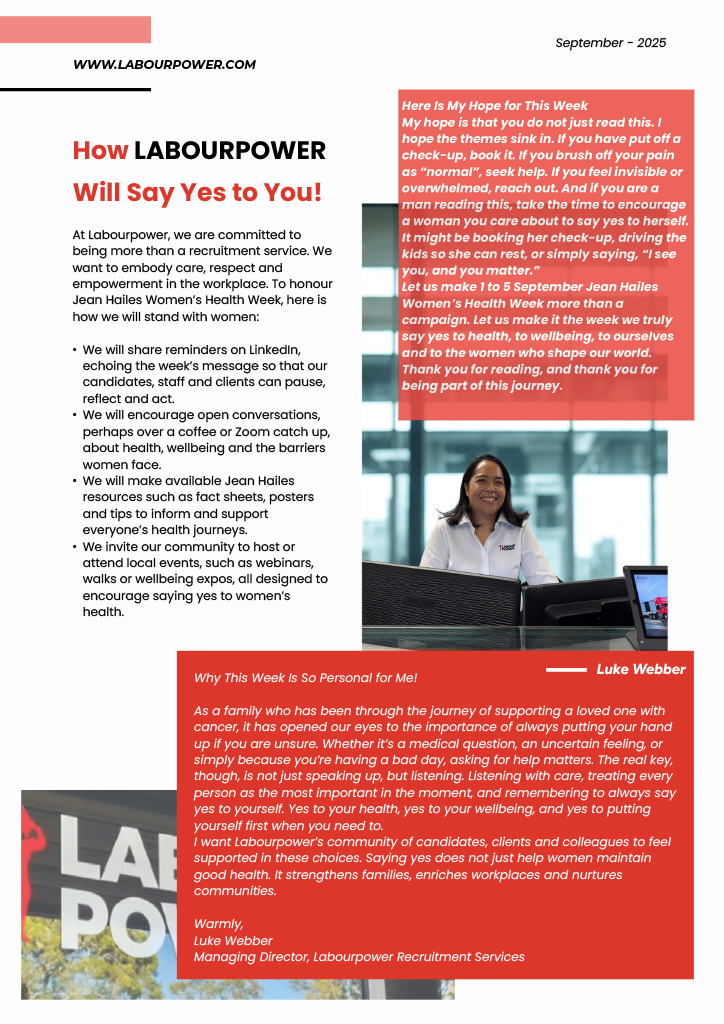
“SAY YES TO YOU” A FATHER’S PERSPECTIVE ON JEAN HAILES WOMEN’S HEALTH WEEK

This Women’s Health Week, we sat down with our Managing Director, Luke Webber, to discuss the personal significance of this year’s campaign theme, “Say yes to you”, as both a leader and a father. We hope that you enjoy our meaningful conversation and embrace the message to prioritise women’s health and wellbeing (and take action!) – whether for yourself or the important women in your life.


I want Labourpower’s community of candidates, clients and colleagues to feel supported in these choices. Saying yes does not just help women maintain good health. It strengthens families, enriches workplaces and nurtures communities. ” – Luke Webber


Each year, from 1 to 5 September, Australia marks Jean Hailes Women’s Health Week. It is a time when we devote ourselves to conversations, actions and awareness that support the health and wellbeing of women, girls and gender-diverse people. This year’s theme, “Say yes to you”, calls us all to pause and put ourselves first for once. It is a powerful reminder of what truly matters: reclaiming time, energy and intention for our own health. (jeanhailes.org.au)


HOW LABOURPOWER WILL SAY YES TO YOU!


At Labourpower, we are committed to being more than a recruitment service. We want to embody care, respect and empowerment in the workplace. To honour Jean Hailes Women’s Health Week, here is how we will stand with women:

  • We will share reminders on LinkedIn, echoing the week’s message so that our candidates, staff, and clients can pause, reflect and act.
  • We will encourage open conversations, perhaps over a coffee or Zoom catch-up, about health, wellbeing and the barriers women face.
  • We will make available Jean Hailes resources such as fact sheets, posters and tips to inform and support everyone’s health journeys.
  • We invite our community to host or attend local events, such as webinars, walks or wellbeing expos, all designed to encourage saying yes to women’s health.


For the complete story, including Luke’s perspective and personal messages, please be sure to check out the article above.


CONNECT WITH LABOURPOWER


Want to learn more about working with Labourpower to find your next great job or terrific candidate? Reach out to your nearest Labourpower branch today! Click here for a complete list of locations and contact details.

Follow us on your favourite socials and stay on top of all our latest news and opportunities. Connect with us on LinkedIn, Facebook and/or Instagram!


SCARLETT HAS JOINED OUR COVID SAFETY TEAM!

A large proportion of our Labourpower family lives and works in areas deeply impacted by the ongoing pandemic. During this challenging time, the safety and well-being of our team are our top priority. We are always looking for better ways to work and leverage technology, and COVID safety is no exception.

That’s why we are happy to share Scarlett has a new role, and feedback from candidates is that she is making a meaningful difference!


LEVERAGING TECHNOLOGY TO GUARANTEE COMPLIANCE AND SAVE TIME


Scarlett is gathering details and tracking vaccination status

We’re using technology to swiftly reach out and connect with our team to gather details around their vaccination status. Scarlett is helping us comply with NSW and QLD requirements to guarantee our candidates’ vaccination status meets the needs of our clients, particularly within LGAs of concern.

Of the 3,300+ candidates Scarlett has reached, 80% have had their 1st or 2nd shots. Excellent news for the safety and availability of our talent pool and our clients that need great people!

For our candidates that are not yet vaccinated, Scarlett records their intent to be vaccinated and timing so she can follow up. She also makes a note of candidates that do not plan to be vaccinated. This system helps ensure our information is current and only appropriate candidates are considered and placed within LGAs of concern.

Scarlett is helping our team focus on filling essential roles

Through her efficient admin and 24/7 availability, Scarlett is saving our recruitment team substantial working hours. She is freeing up our recruiters to focus on matching the best candidates to the right jobs. We have a strong demand for essential workers, especially in LGAs of concern, and Scarlett is helping us fill roles faster.


ENSURING COVID SAFETY FOR OUR PEOPLE, WORKPLACES AND BUSINESS CONTINUITY


Leveraging technology to meet vaccination requirements quickly and accurately is just one of the ways we are doing our best to ensure the safety of our team, workplaces, and business continuity for our clients.

Rapid Antigen Testing

Many of our clients are taking a proactive approach to COVID safety by providing rapid antigen testing onsite. Going above and beyond to prevent positive cases in the workplace is helping to safeguard our community and minimises the risk of suspending operations.

We’re thankful to be working together with fantastic clients, doing their best to protect our candidates’ health and financial well-being.

COVID Safe Environments

Safety Goes 24/7 at Labourpower – which includes a collaborative approach to COVID safety within our business and close partnership with our clients and candidates. Our HR, WHS, branch and onsite teams work collectively to ensure:

  • Labourpower has an up-to-date COVID safety plan, reviewed regularly in line with evolving government guidelines and restrictions.
  • Each site is COVID compliant, and correct PPE is worn at all times.
  • We speak to every employee who reports feeling unwell or has come into contact with a suspected or confirmed case of COVID to assess potential risk. We communicate this information with our relevant client(s) immediately.
  • Every employee that requires testing provides negative results and is cleared by HR before returning to work to safeguard the health and well-being of our community across all sites.


CONNECT WITH LABOURPOWER


Do you have any questions about current regulations or vaccine requirements? Would you like to discuss your concerns around working in a COVID safe environment with our team? If so, please be encouraged to reach out to your nearest Labourpower branch. Click here for a complete list of contact details.

Follow us on your favourite socials and stay on top of all our latest news and opportunities. Connect with us on LinkedIn, Facebook and/or Instagram!


AT LABOURPOWER – SAFETY GOES 24/7

October each year is Safe Work Australia’s National Safe Work month. It’s a time to commit to building safe and healthy workplaces for Australia.

The 2019 theme of ‘Be a Safety Champion’ highlighted that anyone can be a safety champion in the workplace.

National Safe Work month may be over, but it is vital for organisations to make workplace health and safety a priority all year round. 

We speak to Labourpower’s National Workplace Health and Safety Manager David Chernich about the importance of workplace health and safety (WHS) and why at Labourpower – Safety Goes 24/7.


Why is National Safe Work month important?

National Safe Work month helps raise awareness of workplace health and safety. It gives us an opportunity to highlight Labourpower’s commitment to safety, promote discussion about safety at work and remind everyone of the initiatives we have in place to ensure our team is safe all year round.

Today Labourpower fills over 19,000 casual worker jobs each week with over 970 clients nationally ranging from small independent workplaces to larger well-known brands. Creating a safe and healthy workplace is at the centre of everything we do so that our workers are safe 24/7.

KEEPING OUR WORKERS SAFE AT ALL TIMES

With the variety of industries and workplaces Labourpower supplies to, there is always a risk that injuries may occur in the blink of an eye. Preventing workplace injuries, keeping workers safe at work and getting them back home safely is a priority for Labourpower and this is why our motto is ‘Safety Goes 24/7’.

A safer workforce is a healthier workforce. A healthier workforce is a safer workforce.


Why does Labourpower integrate safety with wellness?

Workplace safety and wellness programs have historically operated independently of each other. Today, there is increasing evidence to show that health improvements lead to safety improvements and safety improvements lead to health improvements.

By continuing with our efforts to integrate the activities of health protection and health promotion, Labourpower aims to create a safer, healthier and more productive workforce.


How have you supported this year’s National Safe Work theme “Be a Safety Champion”?

This year’s theme aimed to demonstrate that anyone, both employers and workers from any occupation or industry can be a champion for work health and safety.

Everyone can support a safety culture at their workplace and promote best practice work health and safety initiatives.*

At Labourpower, we champion a number of initiatives throughout the month to raise awareness with our teams not only about the risks and hazards in the workplace but how to prevent harm. We also continue with our efforts to integrate health protection and health promotion activities.

Labourpower encourages all staff to strive to Be a Safety Champion at work. If you have any concerns or suggestions to help increase safety in your workplace, speak to your Account Manager or Labourpower WHS.


#safety champion #safeworkmonth


*Reference: https://www.safeworkaustralia.gov.au/national-safe-work-month/safety-champion-info

THE IMPORTANCE OF TOOLBOX TALKS

Safety Goes 24/7 at Labourpower and we make it a priority to put the right workplace health and safety measures in place so that all staff can stay safe and well at work.
One of the ways we achieve this is by providing regular on-site Toolbox Talks on a whole range of preventative topics as well as delivering tailored workplace health and safety sessions in response to any issue that may arise in the workplace.

What is a Toolbox Talk?
A Toolbox Talk is another term for a safety meeting, often held with your co-workers at the start (or during) your shift or in response to particular safety concerns in the workplace.
Toolbox Talks are a practical way to remind us that health and safety is an important part of every working day and are particularly valuable for highlighting any changes to systems or known issues.

5 Benefits of Toolbox Talks
We believe that a safer workforce is a healthier workforce, and a healthier workforce is a safer workforce. Here are just some of the reasons why holding regular Toolbox Talks is important to keeping you and your colleagues safe all year round.

1. Increases Safety Awareness
There is always a risk that injuries in the workplace may occur in the blink of an eye, but regular Toolbox Talks can help increase awareness and get everyone on the same page when it comes to thinking about safety and carrying out safe work practices (or a change in process or machinery).

2. Keeps Everyone Alert
Workplace hazards can change at any time, but through regular Toolbox Talks team members can be kept up-to-date about any new risks as they arise including any new safety measures that you need to follow to keep you safe.

3. Reduces Workplace Injuries
Taking part in regular Toolbox Talks ensures that safety is top of mind. This helps to reduce the number of workplace injuries, keep workers safe at work and get them back home safely each day.

4. Refreshes Safety Knowledge
When people get busy at work it can be easy to overlook some of the health and safety measures in place. Toolbox Talks are like short bursts of training that recap the day-to-day safety procedures that need to be followed at all times.

5. Promotes Team Communication
Toolbox Talks are not just about raising awareness of the specific safety issues you need to be across. They also give you a chance to raise any health and safety concerns with your supervisors as well as address any gaps in your safety knowledge.

Safety Goes 24/7
No matter what your job or where you work, Toolbox Talks are important to keeping you safe and well.
Don’t miss Toolbox Tuesdays on the Labourpower Facebook page where you’ll find useful tips to help reduce your risk of injury at work and keep safety top of mind.
#Toolbox Tuesdays #Labourpower

If you have any concerns or suggestions to help increase safety in your workplace, speak to your Labourpower Account Manager or Labourpower WHS.