How to Onboard a Labour Hire Worker Properly (and Why Most Sites Get It Wrong)

The first shift is the highest risk shift.

That’s not a safety slogan. It’s backed by data. Research consistently shows that temporary and labour hire workers are two to three times more likely to be injured in their first days on a new site than their permanent counterparts. And in warehousing, logistics, transport and manufacturing where the hazards are real and the pace is relentless that number isn’t abstract. It’s people getting hurt on their very first day at work.

I’ve been doing WHS for a long time. I’ve walked hundreds of sites across Australia. And I’ll tell you straight the number one gap I see isn’t equipment, it’s not procedures, and it’s not even training. It’s the onboarding of temporary and labour hire workers.

Most sites get it wrong. Not because they don’t care about safety. But because they treat labour hire workers the same way they treat the laminated induction card on the wall as something to get through, not something that actually matters.

This article is about changing that.

Why Labour Hire Workers Are at Greater Risk on Day One

Before we get into what to do, it’s worth understanding why the risk is so much higher on the first shift.

Temporary and labour hire workers arrive at your site without the contextual knowledge that permanent workers build up over weeks and months. They don’t know where the pedestrian exclusion zones are. They don’t know that the dock door on the left sticks. They don’t know that afternoon shift runs hotter and faster than morning shift, or that the supervisor on nights runs things differently to the one on days.

They also face a particular kind of social pressure that permanent workers don’t. They’re new. They want to make a good impression. They’re less likely to ask questions that might make them look inexperienced. They’re less likely to raise a safety concern if it means slowing down the line or drawing attention to themselves.

And from the site’s perspective, there’s often an assumption that a labour hire worker who has worked in warehousing before already knows the basics. That assumption is where the gap lives.

Under the model WHS Act, as a host employer, you have a duty of care to labour hire workers that is identical to the duty you have to your own permanent employees. The agency you work with has obligations too but those obligations don’t transfer away from you when a worker steps through your gate. You are responsible for the safety of every person on your site, regardless of who’s on their payroll.

That’s not opinion. That’s section 19 of the WHS Act.

What Most Sites Actually Do (and Why It Falls Short)

Walk into the average warehouse or distribution centre in Australia and ask how they onboard labour hire workers. Most will tell you something like:

– They watch an induction video
– They sign the induction sheet
– They get a site map and an emergency evacuation plan
– Someone shows them where their workstation is
– Off they go

That process might take twenty minutes. It might take ten. And for the site, the box is ticked.

The problem is that an induction is only useful if it connects to the actual work the person is about to do, in the actual environment they’re about to do it in, with the actual hazards they’re going to face. A generic induction video even a good one doesn’t do that. It can’t.

There are a few other common failures worth naming directly:

The buddy system that isn’t. Many sites assign a buddy or a “show-around” person to a new labour hire worker. In practice, that buddy is often another production worker who’s under their own output pressure. The new worker follows them around for twenty minutes, gets shown where the toilets are, and that’s considered adequate supervision.

Forklift traffic that nobody explains. On sites where forklifts and pedestrians share space which is most sites the traffic management plan is rarely walked through in any meaningful way on day one. New workers often don’t know which areas are exclusion zones, what to do when they hear a forklift reversing alarm, or where to stand when a dock is being loaded.

The assumption of prior knowledge.”They’ve worked in warehouses before” is one of the most dangerous assumptions a site manager can make. Working in a warehouse doesn’t mean they know *your* warehouse. Every site is different. Racking layouts, traffic flows, emergency procedures, PPE requirements, reporting processes all of it is specific to your site.

No check-in at end of shift. A meaningful onboarding process doesn’t end when the worker starts. It includes a check-in at the end of the first shift did anything happen? Did anything feel unsafe? Was there anything they weren’t sure about? That five-minute conversation is one of the most valuable safety tools available, and almost no site does it.

What a Proper Day-One induction Actually Looks Like

Here’s what a proper onboarding process for a labour hire worker looks like in practice. This isn’t a theoretical framework it’s what actually works on sites that have low incident rates and strong safety cultures.

1. Pre-arrival preparation

Before the worker arrives on site, your team should know:

– Who they are, what role they’re filling, and what their relevant experience is
– Whether there are any specific physical requirements or restrictions relevant to the role
– Which team or work area they’re being placed into and who their direct supervisor is for the day
– What hazards are present in that specific work area not the site generally, but the specific area

The labour hire agency should be providing you with this information as part of placement. If they’re not, that’s a gap in your host employer agreement worth addressing.

2. A site-specific induction not a generic one

The induction for a labour hire worker should cover the same ground as the induction for a new permanent employee. That means:

– A physical walkthrough of the site, not just a map
– Forklift and pedestrian traffic management where the exclusion zones are, what the rules are, what to do when a forklift is operating nearby
– Emergency procedures specific to the site exits, muster points, who to report to
– Hazard identification relevant to their specific work area racking, machinery, chemical storage, manual handling risk areas
– PPE requirements what’s required, where to get it, what to do if equipment is damaged or missing
– Reporting procedures how to report a hazard, how to report a near miss, who to speak to if something doesn’t feel right
– Site-specific rules speed limits in the yard, phone use, break areas, signing in and out

This walkthrough should be conducted by a supervisor or team leader, not delegated to another production worker. It should take at least 45 minutes. That is not excessive. That is appropriate.

3. A task-specific briefing before work begins

Once the general site induction is done, there should be a specific briefing on the tasks the worker will be performing that day. This is separate from the general induction and should cover:

– Exactly what tasks they’ll be doing and in what sequence
– The correct method for each task, including any specific manual handling techniques
– Any machinery or equipment they’ll be using and how to use it safely
– Who to ask if they’re unsure about anything
– What to do if the task changes during the shift

This doesn’t need to be a formal training session. It can be a fifteen-minute conversation with their direct supervisor before the first task begins. But it needs to happen.

4. Assign a genuine buddy and make the buddy accountable

If you’re using a buddy system, make it real. A genuine buddy is a permanent worker who understands that their job for that shift is to keep an eye on the new person, answer questions, and flag anything that doesn’t look right. They’re not doing that in addition to their full normal workload their supervisor knows they’re acting as a buddy today and adjusts expectations accordingly.

The buddy should check in with the new worker at regular intervals throughout the shift at minimum at mid-morning, at lunch, and mid-afternoon. Not to check output. To check in as a person.

5. Supervisor visibility during the first shift

The direct supervisor should be physically present on the floor and checking on the new worker during the first shift. Not hovering that creates its own pressure but visibly available and actively paying attention. If the supervisor is in the office for most of the first shift, that’s a problem.

This is especially important during the first hour of work, and again at the start of any new task.

6. An end-of-shift check-in

At the end of the first shift, the supervisor or a nominated team leader should spend five minutes with the new worker. The conversation is simple:

– How did the shift go? Was anything unclear or confusing?
– Did anything happen that felt unsafe or that made them uncomfortable?
– Is there anything they’d like to know more about before their next shift?
– Do they have any questions?

This conversation does two things. It gives the worker a chance to raise any concerns while they’re still fresh. And it sends a clear signal that your site is the kind of place where people can speak up & which is the foundation of a genuine safety culture.

The Host Employer’s Legal Obligations & What You Need to Have in Place

Under the model WHS legislation, host employers have specific obligations when engaging labour hire workers. These aren’t optional extras they’re legal requirements.

You must consult with the labour hire agency about WHS risks. Before a worker is placed on your site, there should be a conversation ideally documented about the specific hazards present in the role and the controls in place to manage them. Many host employers assume the agency handles this. The agency has an obligation too, but your obligation doesn’t disappear because the agency is involved.

You must provide a safe system of work. This means your traffic management, your manual handling procedures, your emergency procedures, your PPE requirements all of it must apply equally to labour hire workers as to permanent employees. If your permanent employees have access to a piece of equipment that makes a task safer and your labour hire workers don’t, that’s a gap.

You must ensure the worker receives adequate training and supervision. “They did the online induction” is not adequate training. Supervision means physical, real-world supervision particularly in the first days on site.

You must have a written host employer agreement with the labour hire agency. This agreement should specify the WHS obligations of both parties, the process for communicating hazards and incidents, and what happens if a worker is injured. If you don’t have one of these, get one.

If you’re unsure whether your current arrangements meet the legal standard, SafeWork Australia has published guidance specifically on the WHS obligations of host employers and labour hire agencies. It’s available at safeworkaustralia.gov.au and it’s worth reading.


A Practical Checklist for Site Managers

Use this before the next labour hire worker steps on your site.

Before arrival:
– [ ] Confirmed role requirements and experience with the agency
– [ ] Identified specific hazards in the work area
– [ ] Nominated a supervisor and a buddy for day one
– [ ] Confirmed host employer agreement is in place with the agency

Day one” morning:
– [ ] Physical site walkthrough completed (min. 45 minutes)
– [ ] Forklift and pedestrian traffic explained and walked
– [ ] Emergency procedures covered — exits, muster points, who to call
– [ ] PPE issued and checked
– [ ] Task-specific briefing completed before first task begins

Day one” during shift:
– [ ] Supervisor visible on floor and checking in during first hour
– [ ] Buddy checking in at regular intervals
– [ ] Worker knows who to speak to if something doesn’t feel right

End of first shift:
– [ ] Five-minute check-in conversation completed
– [ ] Any concerns documented and followed up
– [ ] Worker confirmed ready for next shift

What This Looks Like at Labourpower

At Labourpower, our responsibility to the workers we place doesn’t end at placement. We work with our host employer clients to ensure that the onboarding process for every labour hire worker meets the legal standard and, frankly, goes beyond it.

That means we ask questions before placement about the hazards on site. It means we provide candidates with role-specific information before their first shift. It means our account managers follow up with both clients and workers after the first shift to check in. And it means we’re available to support our clients in reviewing and improving their onboarding processes because when a worker on your site gets hurt, everyone loses.

If you’d like to talk about how your current labour hire onboarding process stacks up, reach out to your Labourpower account manager. We’re not just here to place people. We’re here to make sure they stay safe once we do.

The first shift is the highest risk shift. That’s not going to change. But the risk isn’t inevitable it’s manageable, and it’s manageable through a deliberate, structured, site-specific onboarding process that treats labour hire workers with the same care and attention as permanent employees.

If your current induction takes less than an hour, relies on a video and a signature, and sends a new worker to the floor without physical supervision, it has gaps. Those gaps are where incidents happen.

Fix the process before you need to explain to a regulator or a family why you didn’t.

*Barry Geaitani is the National WHS Manager at Labourpower Recruitment Services. Barry’s Hard Hat Chats is a regular series sharing practical, operational safety insights for leaders in warehousing, logistics, transport and manufacturing.*

*For WHS support or to discuss your site’s onboarding practices, contact Labourpower at labourpower.com.au*

**References & Further Reading:**
– Safe Work Australia  Labour Hire: Host Business Responsibilities: safeworkaustralia.gov.au
Model WHS Act 2011 Section 19 (Primary Duty of Care)
– Safe Work Australia  Preventing Work-related Injuries for Temporary Agency Workers
– Safe Work Australia  Guide for Labour Hire: Duties of Host Businesses and Labour Hire Providers

11/05/2026
2026 Labourhire and National Workforce Planning

The 2026 Reality for Labourhire and National Workforce Planning

Labourhire has always been about flexibility. In 2026, it is also about reliability and intelligence.

National clients are navigating tighter margins, skills shortages, compliance pressure and higher expectations from their own customers. They are managing complex workforce requirements across multiple locations, often with different award conditions, safety frameworks and operational rhythms.

What they want from a labourhire partner is simple, but not easy:

• Faster response times
• Clear visibility of their workforce
• Better communication across every site

When these are missing, the risks escalate quickly.


Speed Matters in Labourhire, But Accuracy Matters More

Speed remains critical. Production lines cannot stop. Transport routes cannot be delayed. Waste collection and FMCG supply chains depend on continuity.

However, national clients in 2026 are not just asking how fast roles can be filled. They are asking how confidently.

The expectation is that labourhire providers can:

• Mobilise at scale
• Maintain consistent onboarding standards
• Deploy job-ready workers quickly
• Respond to last-minute changes without disruption

Speed without process creates risk. Speed supported by systems, experience and national coverage creates confidence.

The most valued national suppliers are those who can move fast while maintaining quality, safety and compliance across every site.


Workforce Visibility Is No Longer Optional

One of the strongest emerging expectations from national clients is visibility.

In 2026, decision-makers want to know exactly what is happening across their workforce, in real time.

They want clarity on:

• Who is on site
• Who is qualified and inducted
• Attendance and reliability
• Incident reporting and safety compliance
• Performance trends across locations

This is especially important for clients managing large numbers of workers across multiple states.

Without visibility, leaders are forced to rely on reactive reporting. With visibility, they can plan proactively, manage risk and improve outcomes.

Labourhire partners who invest in workforce tracking, reporting and communication tools position themselves as strategic partners rather than transactional providers.


Communication Is the Differentiator in Multi-Site Operations

In 2026, communication is no longer a soft skill. It is a commercial advantage.

National clients consistently report that poor communication creates more disruption than labour shortages themselves.

The expectations are clear:

• One point of accountability
• Clear escalation pathways
• Consistent messaging across sites
• Proactive updates, not reactive explanations
• Communication that suits operational environments

For transport, manufacturing and waste clients, communication must work in real time, across shifts and locations.

Labourhire providers who communicate clearly, consistently and commercially stand out in a crowded market.

National Coverage Means Consistency, Not Just Reach

Many providers claim national coverage. In 2026, clients are asking what that really means.

True national coverage is not just having offices in multiple locations. It is the ability to deliver the same standard of service, compliance and workforce quality everywhere.

National clients expect:

• Standardised onboarding and induction
• Consistent safety frameworks
• Aligned compliance processes
• Local knowledge supported by national systems

A national supplier must balance local responsiveness with national governance. This is what enables scale without sacrificing quality.

Casual Employment Still Powers the Workforce

Despite advances in automation and technology, casual employment remains critical to Australia’s industrial workforce.

In 2026, casual workers want clarity, respect and consistency. National clients want reliability, attendance and safety.

The best labourhire models recognise both.

When casual workers are well informed, properly inducted and supported, they perform better. When clients receive consistent delivery and communication, trust grows.

Strong labourhire partnerships align the needs of clients and workers, creating stability in an otherwise flexible workforce.

Emerging Risks National Clients Are Watching Closely

With higher expectations come higher scrutiny.

National clients are increasingly focused on:

• Compliance with Fair Work obligations
• WHS responsibilities across sites
• Data privacy and workforce records
• Chain-of-responsibility risks
• Reputational exposure

Labourhire providers who cannot demonstrate strong governance and transparent processes risk losing national contracts.

Those who can show clear systems, reporting and accountability are seen as low-risk partners.

What This Means for Labourhire in 2026

The labourhire providers winning national clients in 2026 are not just filling jobs. They are enabling operations.

They offer:

• Speed backed by structure
• Visibility through systems and reporting
• Clear communication at every level
• Genuine national coverage
• A partnership mindset

For national clients, this reduces risk, improves performance and supports growth.

For labourhire providers, it builds long-term relationships rather than short-term placements.

The Right National Supplier Changes Everything

In 2026, national clients are not asking for more labourhire providers. They are asking for better ones.

If you are managing a multi-site workforce and relying on casual employment to keep operations moving, the right national supplier can make a measurable difference.

Speed, visibility and communication are no longer nice to have. They are essential.

Ready to Strengthen Your National Workforce?

If you are reviewing your labourhire strategy, scaling across sites, or looking for a partner who understands national operations, now is the time to talk.

Partner with a labourhire provider who delivers national coverage, real-time workforce visibility and communication you can rely on.

Your workforce deserves it. Your operations depend on it.


Tara Brown

05/02/2026


Why Cyber Security Matters in Labourhire Today

Labourhire businesses sit at the centre of Australia’s workforce. Every day, they manage sensitive data linked to jobs, casual employment, payroll, onboarding, licences, and client operations. As the labourhire sector becomes more digital, cyber security is no longer an IT issue alone. It is a workforce issue, a trust issue, and a commercial risk.

From manufacturing and transport to waste, FMCG and logistics, labourhire providers handle thousands of candidate records and client systems. A single cyber breach can disrupt operations, delay wages, expose personal information, and damage long-standing partnerships. Cyber security for labourhire is about protecting people, protecting jobs, and protecting the continuity of the workforce.

This article explores the current cyber threats facing labourhire businesses and outlines practical safeguards that protect candidates, clients, and casual employment arrangements across Australia.


The Cyber Threat Landscape Facing Labourhire and the Workforce

1. Phishing Attacks Targeting Casual Employment Data

Phishing remains one of the most common cyber threats across labourhire. Fake emails, texts, or login pages are designed to trick staff or candidates into handing over passwords or personal details. For labourhire businesses, this can mean unauthorised access to workforce systems containing resumes, licences, payroll details, and job placements.

Casual employment models increase this risk due to high volumes of onboarding, frequent system access, and time-critical communication.

2. Payroll and Banking Fraud in Labourhire Jobs

Cyber criminals increasingly target payroll systems. By changing bank details or intercepting payroll processes, attackers can redirect wages, impacting candidates directly and eroding trust in the labourhire provider.

For candidates relying on weekly pay, even one incident can have serious financial and emotional consequences.

3. Ransomware Disrupting Workforce Operations

Ransomware attacks lock businesses out of their systems until a ransom is paid. In labourhire, this can shut down access to timesheets, compliance records, job scheduling, and client reporting. For workforce-intensive industries like transport and manufacturing, downtime can quickly escalate into operational chaos.

4. Data Breaches and Privacy Violations

Labourhire businesses hold large volumes of personal information, including identity documents, right-to-work checks, medical clearances, and licence details. A breach can trigger mandatory reporting obligations, regulatory scrutiny, and reputational damage.

Why Cyber Security Is a Trust Issue in Labourhire

Protecting Candidates and Casual Workers

Candidates trust labourhire providers with their personal information so they can access jobs and maintain employment. Cyber security failures can expose them to identity theft, financial loss, and stress. Strong data protection demonstrates respect for the workforce and reinforces ethical recruitment practices.

Protecting Clients and Workforce Partnerships

Clients expect labourhire partners to operate securely within their supply chain. A cyber incident within a labourhire provider can create downstream risk for manufacturing plants, transport networks, and FMCG operations. Cyber security is now part of commercial due diligence.

Meeting Australian Legal Obligations

Australian labourhire businesses must comply with privacy and data protection laws, including obligations under the Privacy Act and industry-specific requirements. Regulators increasingly expect proactive cyber risk management, not reactive responses.

Authoritative guidance is provided by the Office of the Australian Information Commissioner and the Australian Cyber Security Centre, both of which emphasise prevention, governance, and staff awareness.


Practical Cyber Security Safeguards for Labourhire Businesses

1. Secure Workforce Systems and Access Controls

Limit access to candidate and client data based on role. Use strong passwords, multi-factor authentication, and regular access reviews. Casual employment models benefit from automated deactivation of accounts when assignments end.

2. Train Staff and Candidates on Cyber Awareness

Cyber security is a people issue. Regular training helps recruiters, payroll teams, and candidates identify phishing attempts and suspicious activity. Simple awareness campaigns reduce risk significantly across the workforce.

3. Protect Payroll and Financial Processes

Introduce dual approvals for bank detail changes, payroll file encryption, and regular audits. These controls are essential in labourhire environments with high transaction volumes and tight payroll deadlines.

4. Encrypt and Back Up Workforce Data

Encryption protects data if systems are compromised. Secure backups ensure labourhire operations can continue even after a cyber incident. Backups should be tested regularly and stored securely.

5. Have a Cyber Incident Response Plan

Preparation reduces damage. A clear response plan ensures fast action, regulatory compliance, and transparent communication with candidates and clients if an incident occurs.

6. Work with Secure Technology Partners

Choose workforce platforms, payroll systems, and recruitment software that meet Australian cyber security standards. Technology decisions directly impact data protection across jobs and casual employment.


Cyber Security as a Competitive Advantage in Labourhire

Strong cyber security is not just about risk reduction. It is a differentiator. Labourhire providers who invest in secure systems, transparent processes, and workforce education demonstrate leadership, professionalism, and long-term thinking.

Clients want partners who protect their operations. Candidates want employers who respect their data. Cyber security supports workforce stability, brand reputation, and sustainable growth.


Protect Your Workforce Before Risk Becomes Reality

Cyber threats are not slowing down. Labourhire businesses that act now will protect their candidates, safeguard client relationships, and strengthen workforce resilience.

If you are reviewing your labourhire cyber security practices or want to understand how secure workforce systems protect jobs and casual employment, now is the time to act.

Talk to a labourhire partner who takes cyber security seriously and protects people as well as placements.


Tara Brown

21/01/2026


The Skilled Trade Shortage: What’s Driving Demand in 2026


Across Australia, the skilled trade shortage has moved from a looming concern to a critical operational challenge. In 2026, demand for qualified tradespeople continues to outpace supply, placinng pressure on manufacturing, FMCG, transport and logistics, warehousing and waste management operations nationwide.

This shortage is not the result of a single issue. It reflects a combination of ageing workforces, infrastructure investment, evolving compliance requirements and shifting workforce expectations. In response, employers are increasingly relying on workplace learning, flexible learning, online courses and targeted upskilling to maintain productivity and manage risk.

Labourpower works closely with national clients and sees this demand intensifying across regions, particularly for skilled roles that are essential to operational continuity.


Why Skilled Trades Are in Short Supply

Skilled trades form the backbone of Australia’s industrial economy. Electricians, fitters, mechanics, maintenance technicians and licensed operators play a critical role in keeping facilities, fleets and infrastructure running.

However, several factors have contributed to ongoing shortages:

  1. A large portion of the skilled workforce is approaching retirement
  2. Apprenticeship completion rates have not kept pace with demand
  3. Competition for skilled labour has intensified across industries
  4. Project-based work and infrastructure investment are absorbing talent

As demand increases, employers are finding it more difficult to secure experienced tradespeople at short notice, particularly across multi-site operations.


Manufacturing and Infrastructure Investment Fuel Demand

One of the strongest drivers of skilled trade demand in 2026 is continued investment in manufacturing capability, infrastructure projects and supply chain resilience.

Manufacturing facilities are upgrading equipment, automating processes and expanding capacity. These changes require skilled trades to install, maintain and operate complex systems. At the same time, infrastructure projects are drawing from the same talent pool, increasing competition for labour.

This demand places pressure on employers who rely on skilled trades to meet production targets, safety requirements and maintenance schedules.


Compliance and Safety Expectations Are Rising

Skilled trades are subject to increasingly stringent compliance and safety requirements. Licensing, certifications and site-specific credentials are now essential for many roles.

According to Safe Work Australia, inadequate training and competency gaps continue to contribute to workplace incidents. As a result, employers are strengthening their expectations around documented skills and ongoing competency development.

In this environment, experience alone is no longer sufficient. Employers require evidence of capability, and workers must maintain relevant credentials to remain employable.


The Role of Workplace Learning in Closing Skills Gaps

With fewer experienced trades available, employers are focusing on developing capability internally. Workplace learning allows organisations to build skills while maintaining productivity.

Rather than relying solely on external recruitment, employers are using structured learning pathways to:

  1. Develop semi-skilled workers into trade-adjacent roles
  2. Support progression within existing teams
  3. Reduce reliance on a limited external talent pool

Workplace learning embedded into daily operations allows skills to be built progressively, supported by supervision and real-world application.

Labourpower supports clients by aligning workforce supply with learning strategies that strengthen capability while meeting Australian standards.


Flexible Learning and Online Courses for Skilled Workforces

Traditional classroom training often does not suit skilled trade environments. Shift work, remote sites and production demands require more adaptable learning models.

Flexible learning and online courses enable workers to complete training around operational requirements. This approach allows employers to upskill teams without removing them from critical roles for extended periods.

For skilled trades, flexible learning supports:

  1. Faster onboarding into site-specific requirements
  2. Ongoing compliance with licensing and safety expectations
  3. Continuous skill development as technology evolves

In 2026, learning flexibility is essential to maintaining a skilled workforce.


Upskilling as a Workforce Stability Strategy

Upskilling plays a key role in stabilising skilled workforces. When skilled workers feel supported in maintaining and expanding their capability, they are more likely to stay engaged and committed.

Upskilling contributes to:

  1. Improved retention of experienced workers
  2. Safer work practices
  3. Stronger leadership and supervision capability
  4. Reduced downtime caused by skills shortages

For employers, investing in upskilling reduces risk and builds resilience across operations.


Why Recruitment Alone Cannot Solve the Trade Shortage

In 2026, the skilled trade shortage cannot be solved through recruitment alone. The limited supply of experienced trades means employers must adopt broader workforce strategies.

National clients are increasingly seeking recruitment partners who:

  1. Understand trade-specific labour markets
  2. Support onboarding and compliance requirements
  3. Provide access to learning and upskilling pathways
  4. Offer scalable workforce solutions across sites

Labourpower positions itself as a workforce partner that understands the full lifecycle of skilled trade supply, from attraction and placement through to capability development.


Australian Standards and Responsible Workforce Development

All workforce development initiatives must align with Australian legislation and regulatory frameworks. Employers have obligations under Work Health and Safety legislation to ensure workers are trained, competent and supervised.

Training and learning solutions must also align with nationally recognised standards where applicable. Authoritative guidance is available through:

  1. Safe Work Australia
  2. Fair Work Australia
  3. Australian Skills Quality Authority

Labourpower aligns its workforce and learning practices with these frameworks, supporting compliance and responsible workforce development.


What Forward-Thinking Employers Are Doing in 2026

Organisations managing skilled trade shortages effectively are:

  1. Investing in internal capability development
  2. Using flexible learning to maintain skills at scale
  3. Partnering with recruitment providers who understand trade supply challenges
  4. Treating upskilling as a long-term workforce strategy

These employers recognise that skilled labour is not just sourced. It is built.


Partner With Labourpower to Navigate the Skilled Trade Shortage

The skilled trade shortage is expected to continue in 2026 and beyond. Manufacturing, logistics and industrial operations must adapt to remain competitive and compliant.

Labourpower supports national clients with workforce solutions that combine skilled labour supply, workplace learning, flexible learning, online courses and targeted upskilling. This integrated approach helps businesses manage demand, reduce risk and build sustainable capability.

If your organisation is facing skilled trade shortages or planning for future demand, speak with Labourpower about how we can support your workforce strategy.

FROM AWARENESS TO ACTION: IDENTIFYING HAZARDS THAT PROTECT YOUR PEOPLE

Every safe workplace starts with awareness. The moment we recognise and act on hazards, we protect not only compliance and productivity but, more importantly, our people.

Safe Work Australia highlights that identifying hazards is the first step in risk management. Under the model WHS Act, employers (PCBUs) have a duty to spot and address hazards in every workplace environment. This responsibility isn’t just a legal box to tick, it’s about building a culture where workers go home safe – every single day.

When employers identify hazards early, they can:

  • Prevent injury and illness before they occur.
  • Support a healthier, more confident workforce.
  • Build trust with employees by showing that safety is a priority.
  • Maintain compliance with WHS laws and reduce costly downtime.

At Labourpower, we believe safety goes 24/7. That means being proactive in hazard identification and ensuring that every person we place is prepared for safe and effective work from day one.


Why Identifying Hazards Matters


Hazards aren’t always obvious. They may be physical (such as slippery floors or faulty equipment), ergonomic (poor manual handling practices), or even psychosocial (including fatigue, bullying and stress). Employers who make hazard identification a daily habit build stronger safety cultures and more resilient teams.

Safe Work Australia provides clear guidance:

  • Hazards must be identified before work begins, whenever changes occur, and as part of regular reviews.
  • Workers must be consulted, as they often notice risks firsthand.
  • Employers must take steps to eliminate risks where possible, or minimise them as far as reasonably practicable.

Reference: Safe Work Australia – How to Manage Work Health and Safety Risks


Practical Ways Employers Can Identify Hazards


  1. Workplace inspections – Walk through regularly, looking beyond the obvious.
  2. Engage your team – Toolbox talks, feedback loops, and near-miss reporting give real insight.
  3. Use hazard checklists – Cover physical, chemical, biological, ergonomic, and psychosocial hazards.
  4. Review data – Past incidents and near misses are a goldmine of lessons.
  5. Monitor change – New equipment, materials, or processes = new hazards to identify.


Labourpower’s Commitment


When you partner with Labourpower, you don’t just get skilled staff; you get people who have already been inducted in safety awareness and assessed for industry-specific risks. Our teams arrive trained, reliable, and ready to contribute to safe, productive operations.

We know that for employers, identifying hazards is about more than compliance. It’s about protecting lives, maintaining trust, and ensuring that every worker feels supported and valued. And for us, it’s personal: every placement is a person with a family to go home to.

This Safe Work Month, take the lead in protecting your workforce by identifying hazards early. Labourpower can help you implement practical hazard awareness strategies while providing a workforce that is safety-ready from day one.

Talk to our team of recruitment specialists today on (02) 8336 6200!


Barry Geaitani
National HSEQ Manager


SAFE WORK MONTH 2025: SAFETY GOES 24/7 AT LABOURPOWER

October marks National Safe Work Month 2025, an initiative led by Safe Work Australia to highlight workplace health and safety across all industries. This year’s theme reminds us to prioritise ‘Safety: Every Job, Every Day’ and make it a reality through a proactive approach to managing WHS risks.

At Labourpower, we live and breathe this philosophy every day!

As the National HSEQ Manager, with over 30 years’ experience in workplace health, safety, environment, and quality management, I’ve seen one truth stand out:

Safety doesn’t clock off at 5 pm – safety goes 24/7.


Safety Goes Beyond the Workplace


For many businesses, safety is seen as something that starts at the warehouse gate and ends at the clock-off siren. But, in labour hire and recruitment, safety follows our people into every corner of their day:

  • On the job, whether driving a forklift, loading freight, or working in an office, hazards must be identified, risks managed, and safe practices followed.
  • On the road, fatigue, distraction, and poor planning can turn commutes or client site travel into serious risks.
  • At home, practising safe lifting, proper ergonomics, and mindfulness around wellbeing can prevent injuries and stress that can spill over into the workplace.

At Labourpower, we encourage our teams and clients to view safety as a 24/7 commitment because a safe worker on shift is supported by safe habits off shift.


Building a Culture of Safety – Not Just Compliance


It’s easy to talk about policies and procedures, but a genuine safety culture is built on trust, leadership, and daily practice.

At Labourpower, we’ve made safety part of our DNA by:

  • Embedding HSEQ inductions into every onboarding process.
  • Running regular toolbox talks with labour hire staff across client sites.
  • Leveraging technology and reporting tools to monitor hazards in real time.
  • Providing mental health support to ensure psychological safety is valued just as highly as physical safety.

In essence, safety is not just a rulebook we hand to employees – it’s a shared value that drives everything we do.


The Current Challenges in Recruitment & Labour Hire


In 2025, the recruitment and labour hire industry faces some pressing safety challenges, for example:

  • Fatigue management – with shift work and high-demand environments, ensuring workers are rested and fit for duty remains a top priority.
  • Manual handling injuries – still one of the biggest risks in warehousing, logistics, and manufacturing.
  • Workforce diversity – adapting safety programs for a multicultural workforce, ensuring training is clear, inclusive, and effective.
  • Psychosocial hazards – stress, workload, and bullying are emerging as major factors impacting staff wellbeing, reinforced by updated WHS regulations.

By staying ahead of these challenges, Labourpower ensures that our clients receive not only skilled staff but also safe, supported staff.


Why Safety Matters to Everyone? Clients, Candidates & Communities


For clients, safety means fewer disruptions, lower costs, and a stronger brand reputation.
For candidates, it means confidence, security, and the knowledge that their employer values them.
Most importantly, for the community, it means families know their loved ones come home safe every day.

At Labourpower, we take pride in being more than a labour hire agency – we are workforce safety partners.


Safe Work Month 2025 – Call to Action


This Safe Work Month, we encourage every business leader, site supervisor, and employee to ask themselves:

What can I do today to make my workplace safer tomorrow?

At Labourpower, we will continue to lead by example, investing in safety, embedding strong practices, and reminding our people that Safety Goes 24/7. Because in the end, nothing matters more than ensuring every person who puts on the Labourpower uniform returns home safe, every single day.


Plan of Action


Safe Work Australia has structured the month around a four-tiered risk-management framework, with a different focus each week:

  1. Identify Hazards
  2. Assess Risks
  3. Control Risks
  4. Review Controls


Week 1: Identify Hazards

In recruitment, this process begins with matching. We map client environments, site conditions, and candidate capabilities through pre-start assessments and site inductions, identifying potential hazards early.

Week 2: Assess Risks

Not all hazards pose the same risk. Therefore, we evaluate the likelihood and severity, prioritising high-impact areas—such as forklift zones, confined spaces, and manual handling—before placements begin.

Week 3: Control Risks

Here’s where we act, for instance:

  • Deploy appropriate PPE (helmets, visibility, gloves).
  • Provide site-specific training, including safe forklift operation and hazard reporting through digital tools like our Labourpower App.

Week 4: Review Controls

Safety isn’t a set-and-forget checklist. Consequently, we conduct regular safety audits and toolbox talks, ensuring controls remain effective and evolve with the worksite.


Hot WHS Trends in 2025


  • Digital Risk Management: Regulators are scrutinising how technology is used for hazard identification and worker communication. Accordingly, employers must ensure tools facilitate real-time reporting without distraction.
  • Psychosocial Safety: Burnout and mental strain are now acknowledged hazards. We integrate psychological risk controls, Peer SafeTea sessions, and mental health awareness during NSWM.
  • Behaviour-Based Safety: Inspired by initiatives like Daracon’s BBS program, we reinforce safe behaviour through leadership visibility, positive reinforcement, and worker feedback loops.


Safe Work Month – How You Can Take Action


A Blueprint for Safety

Strategy Action Step
Leverage Safe Work Australia Resources Utilise their Canva toolkits, posters, SafeTea event ideas, and social media tiles to reinforce safety visually.
SafeTea Toolbox Talk Host a safety-themed morning tea with site-specific discussions to spark meaningful engagement.
Worker Involvement Engage workers in hazard hunts and quick risk-spotting competitions to reinforce ownership and accountability.
Psychosocial Health Check Offer brief mental wellbeing check-ins, guided by EAP/safety advisors.
Digital Audits Share workplace safety survey links via your internal network to gather quick feedback and gain valuable risk insights.


With 30+ years in safety leadership, I’ve seen firsthand that safety is rarely the most visible aspect—until it’s missing. National Safe Work Month 2025 isn’t just a calendar entry. It’s a national reminder that safety must come first in every shift, every job, every day.

Let’s make safety real, practical, and universal. Because every Australian deserves to return home safely every day.

– Barry Geaitani, National HSEQ Manager


Resources & Further Reading


Looking for a recruitment partner who puts safety first? At Labourpower, safety isn’t just a policy – it’s a promise. Contact us today to discover how our labour hire solutions keep your workforce safe, strong, and supported 24/7!


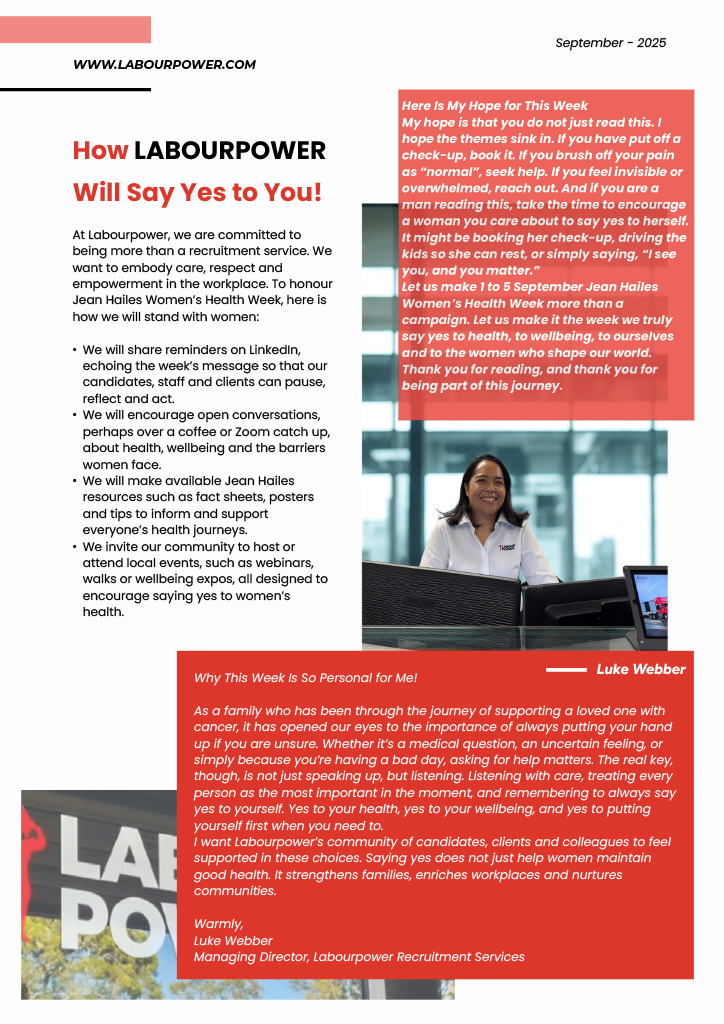
“SAY YES TO YOU” A FATHER’S PERSPECTIVE ON JEAN HAILES WOMEN’S HEALTH WEEK

This Women’s Health Week, we sat down with our Managing Director, Luke Webber, to discuss the personal significance of this year’s campaign theme, “Say yes to you”, as both a leader and a father. We hope that you enjoy our meaningful conversation and embrace the message to prioritise women’s health and wellbeing (and take action!) – whether for yourself or the important women in your life.


I want Labourpower’s community of candidates, clients and colleagues to feel supported in these choices. Saying yes does not just help women maintain good health. It strengthens families, enriches workplaces and nurtures communities. ” – Luke Webber


Each year, from 1 to 5 September, Australia marks Jean Hailes Women’s Health Week. It is a time when we devote ourselves to conversations, actions and awareness that support the health and wellbeing of women, girls and gender-diverse people. This year’s theme, “Say yes to you”, calls us all to pause and put ourselves first for once. It is a powerful reminder of what truly matters: reclaiming time, energy and intention for our own health. (jeanhailes.org.au)


HOW LABOURPOWER WILL SAY YES TO YOU!


At Labourpower, we are committed to being more than a recruitment service. We want to embody care, respect and empowerment in the workplace. To honour Jean Hailes Women’s Health Week, here is how we will stand with women:

  • We will share reminders on LinkedIn, echoing the week’s message so that our candidates, staff, and clients can pause, reflect and act.
  • We will encourage open conversations, perhaps over a coffee or Zoom catch-up, about health, wellbeing and the barriers women face.
  • We will make available Jean Hailes resources such as fact sheets, posters and tips to inform and support everyone’s health journeys.
  • We invite our community to host or attend local events, such as webinars, walks or wellbeing expos, all designed to encourage saying yes to women’s health.


For the complete story, including Luke’s perspective and personal messages, please be sure to check out the article above.


CONNECT WITH LABOURPOWER


Want to learn more about working with Labourpower to find your next great job or terrific candidate? Reach out to your nearest Labourpower branch today! Click here for a complete list of locations and contact details.

Follow us on your favourite socials and stay on top of all our latest news and opportunities. Connect with us on LinkedIn, Facebook and/or Instagram!


SCARLETT HAS JOINED OUR COVID SAFETY TEAM!

A large proportion of our Labourpower family lives and works in areas deeply impacted by the ongoing pandemic. During this challenging time, the safety and well-being of our team are our top priority. We are always looking for better ways to work and leverage technology, and COVID safety is no exception.

That’s why we are happy to share Scarlett has a new role, and feedback from candidates is that she is making a meaningful difference!


LEVERAGING TECHNOLOGY TO GUARANTEE COMPLIANCE AND SAVE TIME


Scarlett is gathering details and tracking vaccination status

We’re using technology to swiftly reach out and connect with our team to gather details around their vaccination status. Scarlett is helping us comply with NSW and QLD requirements to guarantee our candidates’ vaccination status meets the needs of our clients, particularly within LGAs of concern.

Of the 3,300+ candidates Scarlett has reached, 80% have had their 1st or 2nd shots. Excellent news for the safety and availability of our talent pool and our clients that need great people!

For our candidates that are not yet vaccinated, Scarlett records their intent to be vaccinated and timing so she can follow up. She also makes a note of candidates that do not plan to be vaccinated. This system helps ensure our information is current and only appropriate candidates are considered and placed within LGAs of concern.

Scarlett is helping our team focus on filling essential roles

Through her efficient admin and 24/7 availability, Scarlett is saving our recruitment team substantial working hours. She is freeing up our recruiters to focus on matching the best candidates to the right jobs. We have a strong demand for essential workers, especially in LGAs of concern, and Scarlett is helping us fill roles faster.


ENSURING COVID SAFETY FOR OUR PEOPLE, WORKPLACES AND BUSINESS CONTINUITY


Leveraging technology to meet vaccination requirements quickly and accurately is just one of the ways we are doing our best to ensure the safety of our team, workplaces, and business continuity for our clients.

Rapid Antigen Testing

Many of our clients are taking a proactive approach to COVID safety by providing rapid antigen testing onsite. Going above and beyond to prevent positive cases in the workplace is helping to safeguard our community and minimises the risk of suspending operations.

We’re thankful to be working together with fantastic clients, doing their best to protect our candidates’ health and financial well-being.

COVID Safe Environments

Safety Goes 24/7 at Labourpower – which includes a collaborative approach to COVID safety within our business and close partnership with our clients and candidates. Our HR, WHS, branch and onsite teams work collectively to ensure:

  • Labourpower has an up-to-date COVID safety plan, reviewed regularly in line with evolving government guidelines and restrictions.
  • Each site is COVID compliant, and correct PPE is worn at all times.
  • We speak to every employee who reports feeling unwell or has come into contact with a suspected or confirmed case of COVID to assess potential risk. We communicate this information with our relevant client(s) immediately.
  • Every employee that requires testing provides negative results and is cleared by HR before returning to work to safeguard the health and well-being of our community across all sites.


CONNECT WITH LABOURPOWER


Do you have any questions about current regulations or vaccine requirements? Would you like to discuss your concerns around working in a COVID safe environment with our team? If so, please be encouraged to reach out to your nearest Labourpower branch. Click here for a complete list of contact details.

Follow us on your favourite socials and stay on top of all our latest news and opportunities. Connect with us on LinkedIn, Facebook and/or Instagram!


AT LABOURPOWER – SAFETY GOES 24/7

October each year is Safe Work Australia’s National Safe Work month. It’s a time to commit to building safe and healthy workplaces for Australia.

The 2019 theme of ‘Be a Safety Champion’ highlighted that anyone can be a safety champion in the workplace.

National Safe Work month may be over, but it is vital for organisations to make workplace health and safety a priority all year round. 

We speak to Labourpower’s National Workplace Health and Safety Manager David Chernich about the importance of workplace health and safety (WHS) and why at Labourpower – Safety Goes 24/7.


Why is National Safe Work month important?

National Safe Work month helps raise awareness of workplace health and safety. It gives us an opportunity to highlight Labourpower’s commitment to safety, promote discussion about safety at work and remind everyone of the initiatives we have in place to ensure our team is safe all year round.

Today Labourpower fills over 19,000 casual worker jobs each week with over 970 clients nationally ranging from small independent workplaces to larger well-known brands. Creating a safe and healthy workplace is at the centre of everything we do so that our workers are safe 24/7.

KEEPING OUR WORKERS SAFE AT ALL TIMES

With the variety of industries and workplaces Labourpower supplies to, there is always a risk that injuries may occur in the blink of an eye. Preventing workplace injuries, keeping workers safe at work and getting them back home safely is a priority for Labourpower and this is why our motto is ‘Safety Goes 24/7’.

A safer workforce is a healthier workforce. A healthier workforce is a safer workforce.


Why does Labourpower integrate safety with wellness?

Workplace safety and wellness programs have historically operated independently of each other. Today, there is increasing evidence to show that health improvements lead to safety improvements and safety improvements lead to health improvements.

By continuing with our efforts to integrate the activities of health protection and health promotion, Labourpower aims to create a safer, healthier and more productive workforce.


How have you supported this year’s National Safe Work theme “Be a Safety Champion”?

This year’s theme aimed to demonstrate that anyone, both employers and workers from any occupation or industry can be a champion for work health and safety.

Everyone can support a safety culture at their workplace and promote best practice work health and safety initiatives.*

At Labourpower, we champion a number of initiatives throughout the month to raise awareness with our teams not only about the risks and hazards in the workplace but how to prevent harm. We also continue with our efforts to integrate health protection and health promotion activities.

Labourpower encourages all staff to strive to Be a Safety Champion at work. If you have any concerns or suggestions to help increase safety in your workplace, speak to your Account Manager or Labourpower WHS.


#safety champion #safeworkmonth


*Reference: https://www.safeworkaustralia.gov.au/national-safe-work-month/safety-champion-info